
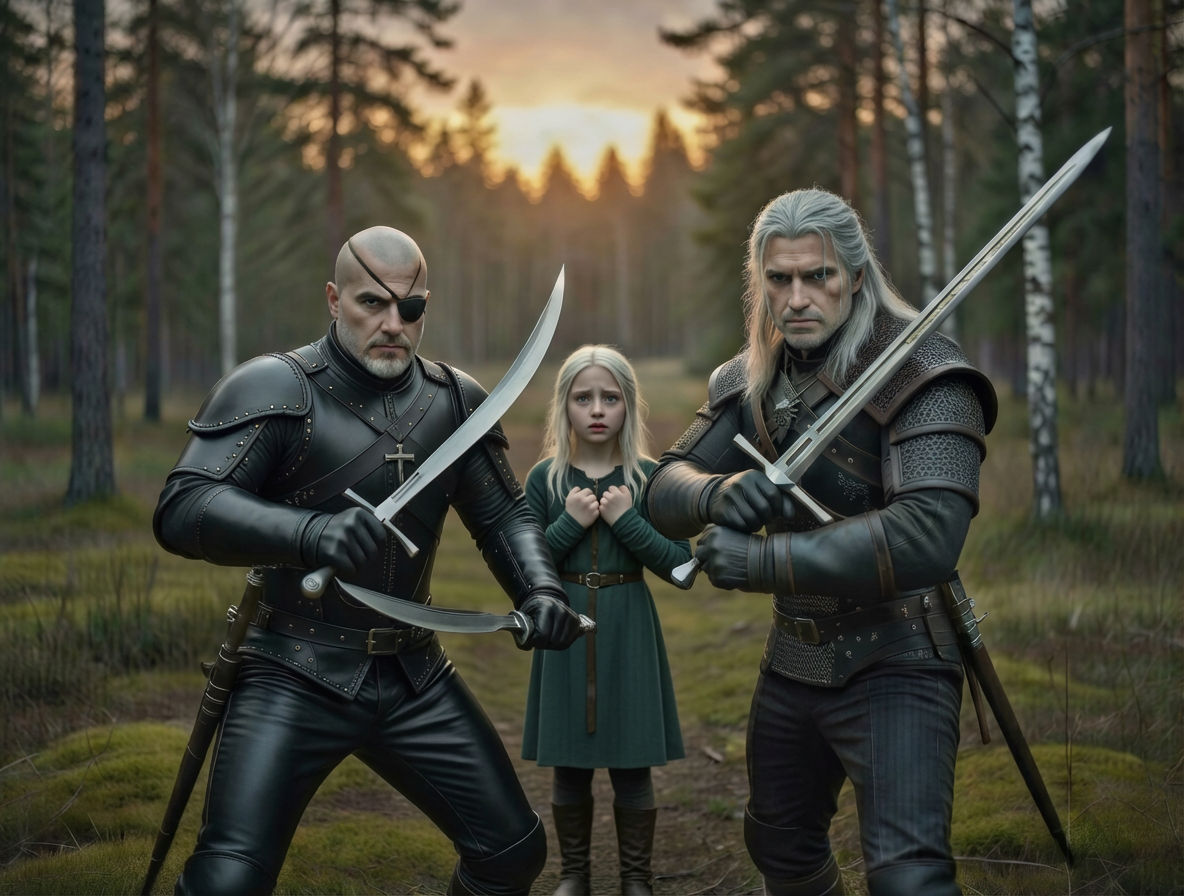
After reading The Last Wish back in 2022, while deployed to Kuwait, I fell in love with Sapkowski’s writing!
I had my share of laughs and wonders with his short stories.
Walking through the desert terrain of the base while reading the book has left me fond memories.
I fell in love with it!
It’s a weird sort of Stockholm Syndrome that I reminisce about and associate with when I think about T.L.W.


To maintain the fanaticism of The Witcher series, I gave Season 2 of the Netflix adaptation a chance. Even if Season 1 was… okay.
I garnered some optimism in the hopes it would improve and fill my witcher hunger.
Instead, it left me bulimic.
Fast forward to December 2024, I was still starving of Witcher quality.
But I received my copy of Sword of Destiny by Andrzej Sapkowski.
My good friend, Justin Shimrock of Shimrockdesign (check him out, he’s great, you’ll love him) gifted me a beautiful, hardcover copy for Christmas.
And it is gorgeous!

After a two-year gap from reading T.L.W., I read it again to prepare myself for S.o.D.!
Although after writing about T.L.W., it should be noted that the timing didn’t matter because the chronology doesn’t matter.
Or did it?
I wanted to ensure the details were fresh in my head.
And it was rewarding.
What S.o.D. does so well is what T.L.W. doesn’t do.
It’s not about the monsters, the world, or the politics within the continent of The Witcher series.
It’s about the quiet, the private, and the sentimental stories of the individual.
The book shows the values Geralt holds and balances out in an ever-changing world. All that while one epoch dies and another begins.
If T.L.W. is about Geralt mediating between monstrosity and humanity, then S.o.D. is about Geralt mediating between his witcher training and experiences against his human emotions and conscience.

The best description that’s apropos for this book comes from Super Bunnyhop’s video Replaying The Witchers: Part 2:
“The stories are less about what a cool dude Geralt is and more about what a confused dude Geralt is.”
And he’s right.
What’s fascinating to me is that this book is the most beloved in the community. But took forever and a day to get an English translation.
Remember, S.o.D., the first book, came out in ’92 while T.L.W. was in ’93.
Yet T.L.W. received its English translation back in ’07, shortly before The Witcher videogame release.
Meanwhile, S.o.D. received its translation in 2015, two days after The Witcher 3: Wild Hunt.
A near 25-year gap since its Polish publication!
Why did it take so long?
According to a Reddit post, the translation process was rough, like a certain game’s glitchy launch that I know about.
The English publishers, Gollancz and Orbit, were uncertain of how S.o.D. would be received in English-speaking markets after T.L.W.’s okay reception.
They just weren’t confident.


So, what’d they do?
They skipped S.o.D. outright and published Blood of Elves, the first saga book, with its translation in 2008.
They believed a full-length novel was more marketable than T.L.W.’s or S.o.D.’s anthological format.
Another problem was Danusia Stok’s unavailability.
Due to production delay, the publishers instead chose David French for translation. He was also responsible for translating other Witcher books.
By the time The Witcher 3: Wild Hunt approached its release date, CD Projekt Red had done a hell of a job in building The Witcher IP.
It had its following, its titanic presence, and its foundation to ensure success in marketing.
With all that considered, the English-speaking publishers had enough confidence to believe S.o.D. would be welcomed by the community.

Two days after The Witcher 3: Wild Hunt’s release, S.o.D. was finally translated, published, and released on May 21st, 2015.

But if you were a cholesterol-filled ‘Murican like me, you had to wait until December 1st of the same year to get a copy.

And if you were me, you’d have to wait until 2024 when your friend got you a copy for Christmas.
Because Jolly Ol’ Saint Nick thought you were too much of a naughty boy for 9 straight Christmases.
That son of a bitch…
It’s not my fault women keep falling for me to give me a good time!

Anyways…
You’re probably asking, “But mister handsome Dark Legend, could you get to the point!? Tell me if the book is good or not!”
To which I reply, “Well, jebus, does it not sound like I have some form of investment and burning passion with this book!?”
Once again, does a bear poop in the— *Sigh*, never mind.
The thing that struck me was how I was prepared to read more epic adventures and conflicts with its metamodern twists that was in T.L.W.
If you were to look at the cover of the book and read the first story, The Bounds of Reason, you’d think, “Alright, we’re getting into it now!”

But by the time you get to the second story, A Shard of Ice, you realize something odd.
The pace slows down and the narrative gets deep and personal for Geralt.
The slow, introspective pacing threw me off at first.
But upon reflection, its ingenuity was revealed to me: it’s not about the real-time adventuring.
It’s about the meaning that emerges after the story ends.
When you consider the chronological juxtaposition of T.L.W. and S.o.D., you realize how disarming the experience can be, resulting in something compelling.
If you read my piece for Goddess of Victory: Nikke and my small mention of Kojima’s way in handling the Metal Gear Solid series, you can understand where I’m coming from.
Sapkowski does something similar with the two books.
T.L.W. gives you the impression of what the rest of The Witcher series may look like.
But when you get into S.o.D. with those expectations, you find yourself disarmed and unprepared for what you’re about to walk into.
The narrative beats the living hell out of you, and you experience the pain that Geralt endures.
In retrospect, it would not have the same effect if you were to read it in official chronological order, vis-à-vis, S.o.D. followed by T.L.W.

In fact, to get the most sublime, compelling, profound, and emotionally driven smack to the face, S.o.D. DEPENDS ENTIRELY on reading T.L.W. first!
It’s no wonder why the consensus of The Witcher community ranks S.o.D. as the #1 book of the whole saga.
David French’s translation feels more fluid and natural that Danusia Stok’s solid Work on T.L.W. Although Polish nuances will slip through for non-native readers.
But the stories are superb, nonetheless!
A Little Sacrifice is the paradigm of all stories in S.o.D.
Being a sucker for mermaids, I couldn’t tell you how excited I was to read about one. The rising tension of the story made it even better!

But as I read on… it didn’t turn out the quite the way I expected.
I was bamboozled by the ending!
After much time thinking about it, it suddenly clicked.
The slow-paced, delayed epiphany was not an emotional punch to the face…
It was an absolute crushing force from above with its subtle yet heavy narrative!
Although sometimes slow, I ask readers to be patient because these can be slow burns.
They still have that personality and wit that makes me go “HA!” in public before moving on, but they take time. And rightfully so.
The one thing I loved about S.o.D. is its motif of none other than destiny.

I wasn’t aware at first, but every story in the book is touched by some form of destiny.
But after reading it and meditating, it made all the more sense and moved me on a deep level.
The other theme that I loved was the changing of times and that cycle of ages.
The death of one age is a subject that is brought up in every story. All the while a new one takes its place.
It’s an echo of medieval literature that’s subconsciously ingrained in our storytelling mediums.
Like poets of the Dark Age, Geralt must meditate upon the transience of life and come to terms that nothing lasts forever.
- Not empires.
- Not religions.
- Not stone.
- Not the human body.
- Not even love lasts in this middle earth that we inhabit.
Remember what Aristotle said:

“Time crumbles things; everything grows old and is forgotten under the power of Time.”
– Aristotle
So, in facing this internal and external conflict, Geralt is left with a serious question:
What does life amount to when the world is so unsiker — so insecure, so unsafe, or so unstable — and all will die and fade away under the power of time?
For your consideration in enjoying the book, I will speak no further on the matter.
But I will say this.
Ciri may be the key to Geralt’s answer!
Because Ciri is Geralt’s destiny!

It’s the one thing he fears, and it’s the one thing he may try to avoid, understandably so.
But one thing is certain: It’s the one thing he needs.
After all, we are all bound by destiny, for better or for worse.
So, if you’re a Witcher fan of the game, the previous book, and the anorexic Netflix adaptation, I highly implore you to read Sword of Destiny AFTER The Last Wish!
You will walk away changed… and you will find out what Geralt learned from destiny:
You Cannot Run from It.
Sources
Super Bunnyhop: Replaying The Witchers: Part 2
Reddit: Why it took so long for the Official translation of the books?
The Dark Legend: The Gacha Becomes a Goddess; or, The Transcendence of Nikke