
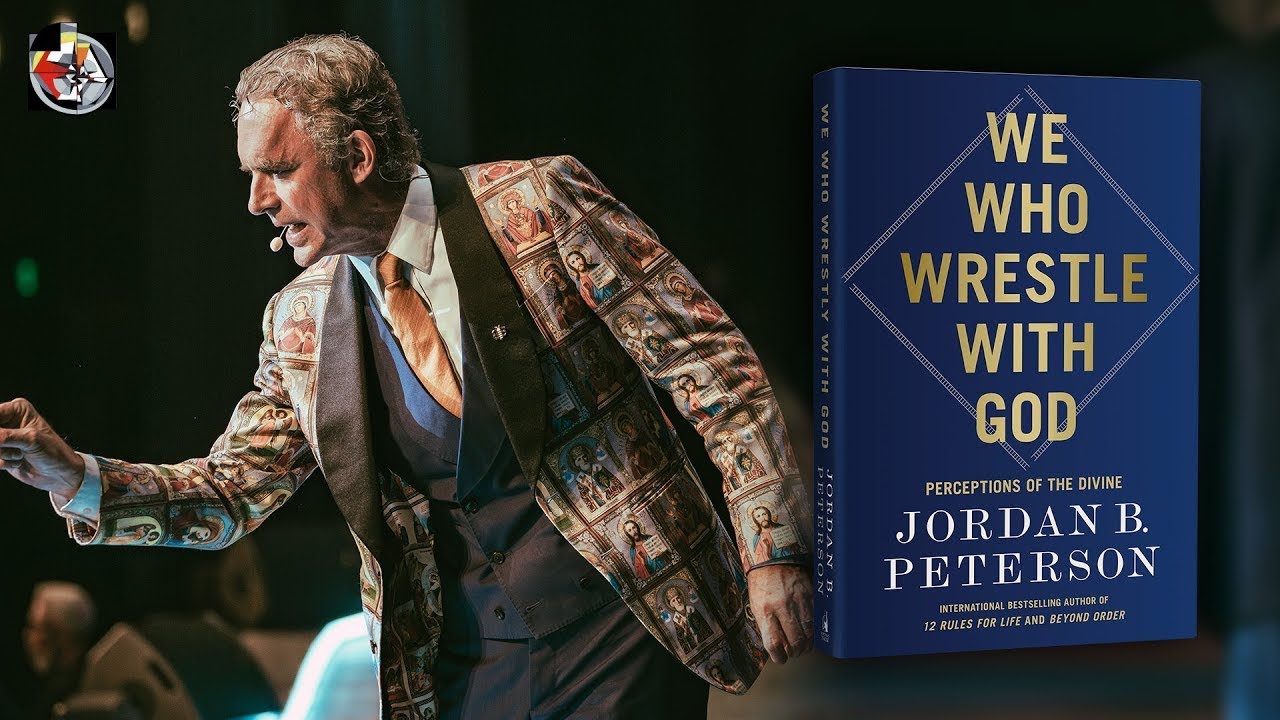
Jordan Peterson’s We Who Wrestle with God: Perceptions of the Divine is his latest book. It covers deep, psychological, interpretations of the stories of The Old Testament, from Genesis to the prophet Jonah.
It was highly anticipated for people who are fans and who with his previous books. Especially 12 Rules for Life and Beyond Order.
No doubt Dr. Peterson is a modern-day, cultural phenomena and has definitely made an impression on the public square. Whether the impressions are praiseworthy or critical, he has definitely made his mark.
Regardless, We Who Wrestle with God is Peterson’s biggest written project yet. And it is definitely not meant for casual reading.
Instead, it challenges the reader to contend with the ideas of the book. This is in the hopes to make him or her see The Old Testament in a nuanced way.
It’s also used as a guide to navigate oneself in these modern times of identity politics, materialism, ideology, and nihilism.
But the question remains: is the book as good as 12 Rules and Beyond Order?

To start, a key theme in the book is how Peterson uses the dichotomy of Order and Chaos.
He has used this before in his previous writings, true enough. But the motif holds up. Peterson always returns to make connections of how much the dichotomy is linked with the stories in The Bible.
What’s more, he relates to how they are connected to us.
This is one of the strengths that We Who Wrestle with God possess as a spiritual/psychological book.
Its main point that these old stories, these mythologies, hold truths that are timeless. We can still use and learn from them!
Whether they are stories of inspiration, like Abrahams adventures, or stories of wariness, like Cain and Abel, they hold truths. About us!
Just as what Tolkien believed.
Additionally, sometimes those truths are complex. They require moments of thought to understand; hence, ideas to wrestle with.
On top of that, these are meta-stories due to the iterative nature of human beings. These scenarios that happen in the Bible are constantly repeated over time as long as humans have been around.
From falls from grace of man and woman, to the murderous ravings of brethren, to the downfall of proud civilizations with cloud-capped towers, and to those tense moments when the prophets listen to that still, small voice to speak the truth against the tyrannical state… these are all that have been repeated throughout time and throughout human history.

It all starts with God creating the world and the introduction of Order meeting Chaos. The spirit of God uses these two elements for creativity and for the creation of the world.
Imagine a spiritual/psychological Big Bang that creates a chain reaction. In that reaction, we see the oscillating ripples of divine reach out and touch the differing archetypes and narratives. Those of the Old Testament and beyond.
Think of it like a hypertext, where one verse relates to another but in all parts of the grand narrative.
All of that starts with the spirit of creativity. It’s all the result of that same spirit.
The point being is we are images of God. And we too have the ability to create and manifest a good, purposeful life by utilizing order and chaos. With that creativity, we all leave those same ripples of our being in life.
That’s how we are remembered by people, our choice in how we manage our lives. But it is all first done with creativity.
Sacrifice, redemption/rebirth, and focus or an aim at the highest possibility play a role further in the book.

As a man of faith, one thing I appreciat about Peterson is how he offers a psychological interpretation of The Bible.
He does so with a level of nuance that allows people, even those with a secular mindset, to understand. And it brings a sound basis to an “outdated” book.
We Who Wrestle with God further carries that formula.
What it offers is justification of the logos or the mindset of The Bible. It brings it to a point where it doesn’t look primitive or outdated.
If anything, it’s sound and logical.
One surprising, personal aspect that I found reading this was how comfortable I was. Unlike in 12 Rules and Beyond Order, I was caught off guard with Peterson’s style of writing.
When I first read his previous books, I was a bit overwhelmed with his style of writing. It was admittedly difficult to understand and keep up with.
His sentences are never simple, flat, or terse and his writings are more akin to something more academic and analytical.
One thing that you’ll pick up reading him is there is NO shortage of thought.
I once let a friend borrow 12 Rules and he couldn’t finish it. He had a hard time understanding the material.


But I think I reached the point where I’m now accustomed to his type of writing. We Who Wrestle with God became easier for me to understand due to me being desensitized to his writing style.
It was just something to be expected from Dr. Peterson.
Not to mention listening to his lectures helped.
Unfortunately, I’m afraid this may be the one “flaw” of this book. It’s simply that this piece may be overwhelming for casual readers.
I wasn’t joking when I said this reading requires thinking or wrestling with. Sometimes I would catch myself stopping mid-sentence and going back to make sure I understood what was written.

Sure, it was engaging, but other casual readers will be left confused, frustrated, lost, or all, over this daunting work.
Apart from that, I did spot some typos that irked me, but nothing serious.
At this point in time, We Who Wrestle with God is a welcoming addition to the colossal battle ground of literature.
That also includes philosophy, science, psychology, and theology.
Why?
Because I’m of the belief that mythologies, like those of The Bible, remain a well of wisdom. People can walk away with something novel and learned.
In truth, the Bible is a meta self-help guide. It’s meant to aid the individual to remain aligned with the Sommum Bonum, the greatest good.
What We Who Wrestle with God does is bring to consciousness the meaning and methods of these stories.
It allows us to interpret these stories to help us in our lives. The utilization of chaos and order is an example of that.
We live in a time where we are filled with social media, materialism, consumerism, ideology, identity politics, nihilism, and more. It’s a constant stimulus that has made us forget what it means to live as decent human beings.
This book helps realign a path for people to take while giving meaning and purpose to their lives.
Even a secularist can follow the same guidance without being preached upon, as that is never Peterson’s goal.
What it offers is realignment for the spirit.
Its like a marriage between the objective and the spiritual.
Between science and religion, between order and chaos, between the conscious and the unconscious, between the psychological and the corporeal, and the community and the individual.
We Who Wrestle with God brings to the light that these stories are not just about the characters in them.
It’s about us as a people on this good earth.
Its about us having the potential to make either a harmonious paradise or a living hell. It all depends on our choices in life.

To conclude, We Who Wrestle with God is a lot to take in.
A LOT.
But that does not mean it is without some treasure of knowledge to gain from it.
It stands as a work that is not only used for academic reading, but as an invitation.
A challenge to allow the reader to grapple with the ideas of the ancient texts of The Old Testament. To use the knowledge that these stories contain.
In reading it, whether its navigating your life with the utilization of order and chaos, the sacrificing of the present to attain a favorable future, or focusing on the highest goal in ones life, there is something to walk away with from this book.

Though its a challenging read, I do recommend it those who are lost in life.
I would further challenge themselves on reading it.
Anyone who is of faith or enjoys a psychoanalysis of mythology, like myself, will find it interesting and utilitarian in their creative works.
Its a daunting book to get into and at times hard to understand. But walking away with the knowledge it offers is its own reward.
Well, thank you very much for listening to my critique, I hope you found it useful. But I want to know if you read it, did you like it? Please comment down below and be respectful with each other.
And hey, if you’re interested in reading this book AND if you want to help me build my site with a small commission, please consider clicking on my Amazon Affiliate Link with no additional cost. Thank you and God bless!