

Preface
This was supposed to be a Goddess of Victory: Nikke review and analysis originally. But after spending nearly a month going down a rabbit hole and writing about the limited-time events, the game that preceded Nikke, and the gacha industry it thrives in, I was not satisfied with the end-result of over 100 pages. I tried again and broke it down to make it more digestible for readers. This will be the first of not 1, not 2, but 3 companion pieces.
Intro
A Brave New Genre
In the late 2010s, a new genre of gaming appeared in our western nerd culture and slowly grew. It originated in Japan in the early 2010s and when it arrived in the west, it had established a foundation for greater prospects.
By late 2020, that genre sky-rocketed in popularity in the form of Genshin Impact and was a phenomenal success.

It generated up to millions and eventually billions of dollars and carved a path for the future of video games, and shifted the dynamics of how games would be played. For better or for worse, it’s a genre that changed everything and it still lives on in popularity.
What genre of video game is this that I’m writing about?
Gacha.
It was an interesting cultural shift and popular trend at the time that gives those feelings of nostalgia in retrospect. I remember going to Anime Expo in L.A. and seeing panels and presentations of Fate Grand Order, a popular gacha title that’s still going.
Sometimes for game night, friends would share with me some collected characters in Fire Emblem: Heroes and other gacha games. People would send me amusing memes or art online, and it was clear gacha was here to stay.

It was more akin to a niche than a mainstream trend. But with the gratuitous COVID-19 lockdowns, the release of Genshin Impact, and people staying at home to play it, the gacha genre became a juggernaut.
I became familiar with some gachas, but I never truly committed to them. They just weren’t like the regular premium games you’d play on console or PC.
I played Fire Emblem Heroes, Fate Grand Order, and Girls’ Frontline, and they were fun! I always had respect and admiration for its niche nature and the community it harbored. But they never stuck with me.
There were also the well-known games like the already-mentioned Genshin Impact, Ark Knights, Honkai Star, Zenless Zone Zero, and the infamous number one sponsor of everyone’s YouTube video, Raid: Shadow Legends.


Ironically, and sadly enough, this piece is not sponsored by them.
I avoided some of these solely because of Tencent’s involvement with them. But that seems like an inevitability since games like Nikke are involved with Tencent… And that’s just sad. That’s a grievance for another time.
The point is these gachas are everywhere and are still running in popularity, generating BILLIONS of dollars!
Although the character designs were appealing and the online communities seemed like fun, I didn’t think much else about gachas. Just that they were too passive for my taste.
To me, gachas were a round of fate that determined whether or not you attained a hot anime character. All with a glamorous aesthetic that subconsciously reminded me of Las Vegas. I wasn’t too far off with those connections either.
I
Don’t Worry, Fam, I Gacha!
If you have a life, or you’re kind of like me and wander in and out of the realm of the internet, missing out or half-understanding trends, popular discussions, memes, and other stuff, you’re probably wondering, “What’s a Gacha? Is that a food?”
The term “Gacha” comes from the word “gachapon” (ガチャポン). In Japan, they are those small toy vending machines you can find at a local Japanese supermarket. The word is an onomatopoeic term for the sounds they made in the Japanese language. “Gacha” for the cranking of the handle and “pon” for the toy capsule landing on the tray.

Every toy prize attained, or “pulled” as they say, had its own rarity and value. Collecting them made it appealing, charming, addicting, and incentivizing people to return for more potential valuable prizes.
The gacha concept remained the same over time, but its medium evolved. From vending machines to digital mediums like cellphones, PCs, console games, and other mobile devices, gacha was here to stay. In fact, Genshin Impact’s success has set a standard where F2P (Free-to-Play) mobile games now play like premium games.
Today, in the digital age, the possibilities of gachas can theoretically be anything.
From the typical sexy-looking anime characters to dragons, to cars, to guns, to gemstones… gachas can be anything.


The way gachas work is essentially a numbers or a lottery game. You spend money (in-game or real currency) and win a certain character, item, upgrade, etc. as a prize.
For the rest of this article, let’s stick with characters as the prime example since that’s usually the targeted outcome.
Once you make the transaction, you “pull” or “roll” and receive a character with a certain rarity.
The crux is that each character has value, making some more valuable than others. Just like the prizes in the original vending machines.
If you look at games like Genshin, you notice every character is rated by a certain number of stars. The stars represent their rarity (4★ being most common, 5★ being rarer).

There may be additional mechanics that make the collected character more valuable with duplicates.
Another example: in Nikke. When you pull an SSR (Super Super Rare) character, they have a level cap of 80. That doesn’t sound impressive for an SSR. But there’s more.

If you attempt to roll again and pull a duplicate, you can raise the level cap up by 40.

This is represented by a fillable 3★ system.

Every duplicate pulled fills a star and raises their cap.

Therefore, if you make 3 successful duplicate pulls, you can upgrade the pulled character up to level 200.

This increases their value and capabilities and makes them a valuable asset in-game.

(Please note: this particular character is synced with my top five strongest characters, which is why she is level 205. This was merely a visual demonstration to show how this duplicate system works.)
That’s the allure of gacha and the reason people get addicted. It’s that drive of wanting to take the chance, make that rare pull, and build your collection. It gives that satisfying feeling of having rare characters that others do not have. But you will spend a lot of money for it, real or otherwise.
There may be variations from game to game, but the gacha mechanics are essentially the same.
It’s like loot boxes, or as the cancerous EA would call them, “surprise mechanics.” All of that with the glamorization of attractive anime characters and art.
In fact, before gacha became popular in the West, loot boxes were the closest that Westerners had. But instead of having an F2P game, you would buy AAA games like Star Wars: Battlefront I or II, FIFA, Madden, or NBA2K-whatever for a full $60-$200 price (depending on game and edition). Then you’d pay EVEN MORE micro-transactions for this loot-box system!
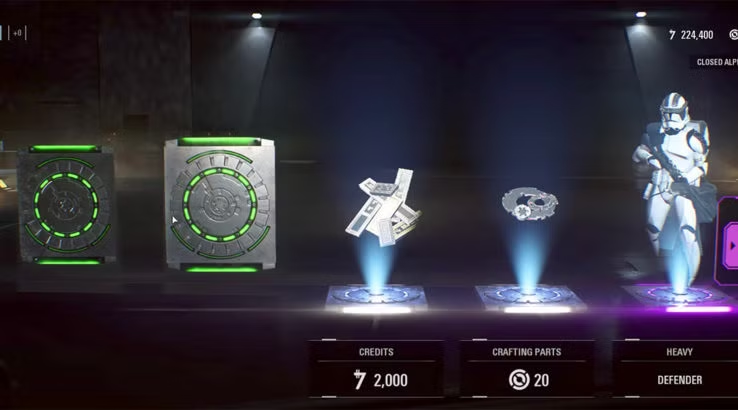
Personally, I always thought this was ridiculous, nefarious, exploitative, scandalous, scummy, unbecoming, and plainly… just f*cking stupid.
This drove much controversy, that court hearings were made about this system. Even Europe banned games that had these “surprise mechanics” as they found them unethical and considered illegal gambling.
It’s one reason I find companies like EA, Ubisoft, or Activision absolutely repulsive and cancerous to the gaming industry.

Gamers eventually had enough with western developers and their “surprise mechanics” scheme. So, they looked to the east where developers seemed to have an interest in making quality products.
With gachas and their F2P system, it became inevitable that they overtook western markets in popularity. It’s where we are now in this industry, billions in the making.
II
We Gambling or Gaming?
Just because gachas were successful doesn’t mean they were short of controversy.
Because of its passive, collecting, “wagering,” and random nature, some people argue gachas are not games. Instead, they are more akin to gambling.
Which raises the first question: can we classify gachas as games?

My answer: Absolutely! A majority of these gachas have mechanics that make them engaging to play.
For instance, Destiny Child, Nikke, Fate Grand Order, and others, are all party builders. They contain RPG elements, which include customization, character selection, battle planning, and more. It just has a passive nature.
And, come on, Genshin Impact looks and plays like The Legend of Zelda: Breath of the Wild. Meanwhile Honkai Star Rail looks like a colorful and stylistic sci-fi J-RPG.
So, yes, I’d say it’s safe to label gachas as games. Especially if they have the element of fun!
Although, quality of the game itself may vary and some people may not enjoy it as much. That’s based on the gacha mechanics at the heart of it. Keep this in mind for later.
Now, this raises the second question: Is gacha gambling?

There are articles and research discussing and debating the nature and ethics of the gacha beast. Including how developers implement casino- like systems in-game.
If you’re interested, I have sources at the end. It may take time to read, but they will paint a clearer picture of the subject.
Normally, gambling requires something of value to wager, an outcome that is based on pure chance or luck, and a concluding prize. But gacha… is a bit more complicated.
My problem in writing this was trying to tie the definition of “gambling” with gacha. But I found some inconsistencies when I thought about comparing gachas to other nerdy mediums.
There’s another hobby that I know that’s arguably slightly closer to gambling and similar to gacha: card collecting.
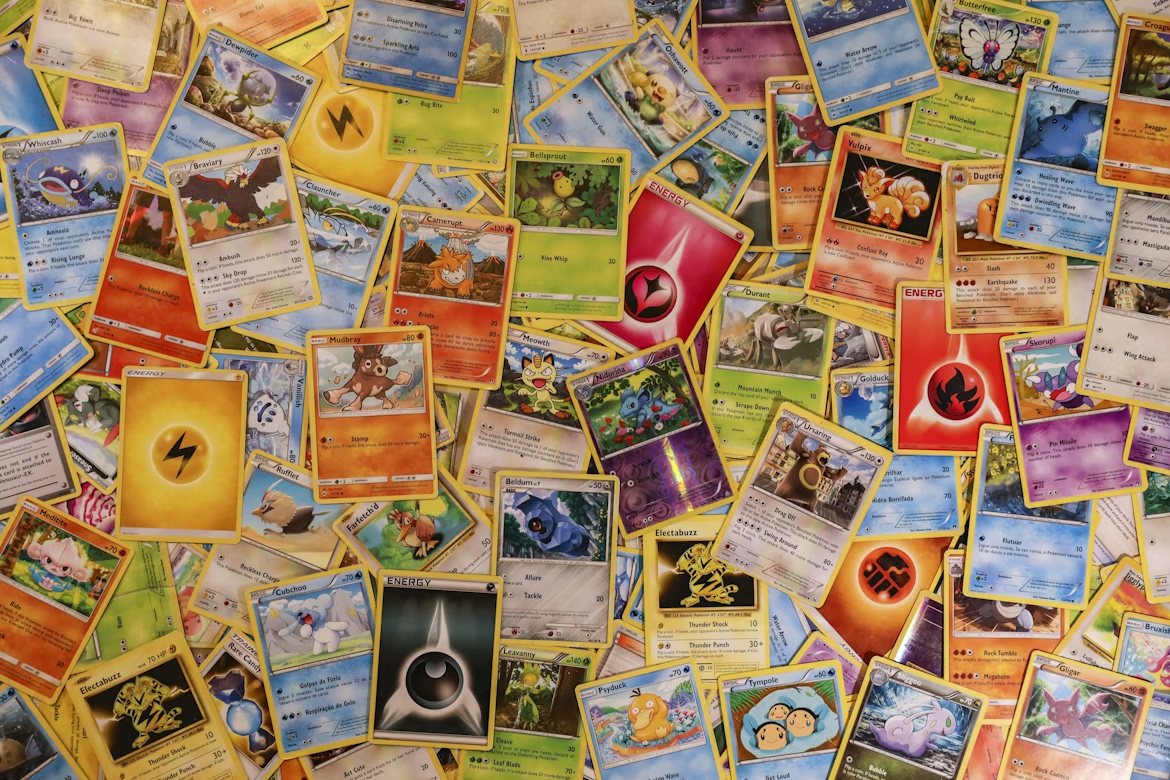
Think about it! If you’re a kid in the 90s who loved Pokémon or Yu-Gi-Oh, but sucked at the games, like me, then you were in it only for the card collecting. You wanted that rare holographic Mewtwo card so badly, along with other rare cards, that you bought dozens of packs in the hopes they contained something that would contribute to your collection.
You’d mostly get stinkers. But every once in a while, there was that one pack that had something good in it. Maybe two or three cards.
Collect enough and you’ve got a stash that’s worth a fortune. And people would pay for it… provided that your mom didn’t throw away your stash that was in the garage. Thanks, mom!
With that in mind, isn’t that similar to Gacha? Yet card collecting is not classified as a form of gambling. And that deals MORE with actual money that can be interchangeable between two parties. Gacha doesn’t do that.
Even my friend, Justin Shimrock, founder of Shimrockdesigns and tattoo artist extraordinaire (love this guy), collects Magic: The Gathering cards. He’s played the game for a long time and outright admits it’s gambling, as each card has a value. Just like gacha!

So why not call it gambling if they’re similar? Furthermore, what does gacha have that disqualifies it from gambling?
The first detail one runs into is a technicality. Because a player can finish a gacha and stick with the F2P route. No money is required; thus, no wager is made.
The drawback is that instead of spending money to make progress, you will spend a lot of time in-game. This slows or halts the game’s pace and acts as a hindrance and a flaw. And that is intentional; to make you spend as much time as possible playing.
The other feature I think gachas have that disqualifies it from “gambling” is the dependence on the generosity. This, of course, varies from game to game.
The less generosity it offers, the closer it is to gambling.
Pseychie, a YouTuber, mentions that the very mechanic he thinks separates gacha from gambling is “The Pity System.”
Putting it simply, a pity system is an insurance mechanic that guarantees a good pull of a rare character after a certain number of failed rolls. The game “takes pity” on the player’s misfortune, hence “The Pity System.”

One example comes from Nikke. When you make a pull, the game will grant you a gold or silver ticket. Those stack over time with every pull you make. Once you have 200 tickets, you can use them to pull an SSR character of YOUR choosing. Guaranteed, of course.
That system is an example of a pity system. Keep in mind that Pity Systems can vary from game to game.
Pseychie makes an excellent point: a gacha has a pity system, whereas a slot machine does not. Therefore, you’re technically not losing anything when trying to make those rare pulls.
To further drive that idea, let’s go back to card collecting! That doesn’t have a pity system! Why not call it gambling?
So, are gachas gambling or not?
As the meme goes:

The problem with gachas is that the systems they have in-game make it difficult to define them as “gambling.”
Like I said: a technicality.
Whether it’s considered gambling or not, that’s for the individual to decide.
So, gacha can’t be harmful if you’re not using money to gamble, right?
Unfortunately, the truth is arguably more psychologically nefarious.
Just because you’re not “gambling,” doesn’t mean there aren’t systems or mechanics that resemble those in casinos.
In fact, subtlety is the essence and nature of gacha.
It’s how it gets more money from customers than they realize.
I know certain individuals would say that it’s all the hyper-sexualized characters in the game that attracts the male audience. But that is just a near-sighted, surface-level step one.
Sex does sell, true enough. These games are set up with situations where players have para-social relationships with the fictional characters of the game.
It is a pull. But the retention goes beyond that.
We’re talking about something that goes into the realm of psychology.
For example, the game intentionally prices in-game currency in off-amounts instead of even. This forces you to think about how much you need when buying a certain amount. See Pseychie’s video for an example.
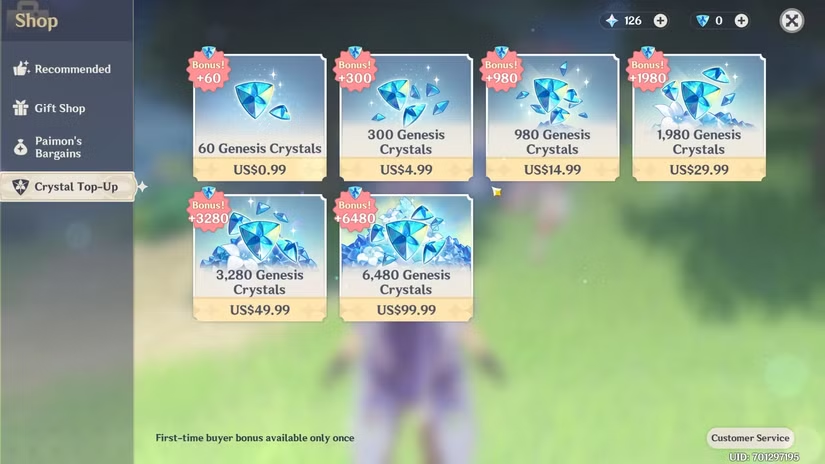
Ideally, you’d want to mind how much you spend to get that eventual good pull. Unfortunately, most players remain unaware of the amount of money spent because of their focus on winning. That or they don’t care.
They only care about matching the prices with in-game currency for rolls; money be damned.
Additionally, FOMO (Fear of Missing Out), limited-time deals, or special events are used as call to action techniques. They intentionally set up unconscious pressures to restrict your mode of thinking. A stressed mind is not a thinking mind after all.
Curiously, in yakkocmn’s video, he cites Natasha Schull’s book, Addiction by Design. In it, he explains gamblers enter a thoughtless stream of stimulation to get hooked onto gambling.
This is called “The Machine Zone.” They don’t play to win; they play to escape. It’s a means to shut your mind and induce yourself into a trance-like state of engagement while time fades away.
Sound familiar?

Remember how I said earlier gachas are made to make you spend as much time as possible on them? That is a retention technique for prolonged engagement. The reason is that instead of getting money, time is the targeted currency.
Why time and not money?
Because time IS money in this industry.
Put yourself in the shoes of a gacha gamer. You want to make the most of your time and work on dailies, weeklies, and maybe monthlies. You want to complete achievements, or even get through the story. And doing all this, they give you in-game rewards.
The more you commit to it, the higher the rewards become.
But for every carrot, there’s a stick.
Designers have made dailies where if you miss just one day, that stack of rewards you’ve built up disappears. This incentivizes players to further commit to the game just to get the most rewards possible.

What’s unconsciously happening is a conditioning in habit building. It makes the gamer continuous play and in reality gives a false sense of productivity.
As you continue, gameplay becomes tedious and cumbersome as you sometimes have to invest in upgrading characters in your roster. Normally, this takes a lot of time. We’re talking about months.
I can attest to this with Nikke. I started playing in late 2023, and admittedly, I stopped twice because of burnout. But to this day I’m still trying to min-max my characters to their full potential without paying! In fact, I recently achieved my first five level 200 characters to sync with others. And they’re STILL not min-maxed!
Bottom line, it takes time to upgrade one of your characters to the max. But to do that for five? You’d have to have the patience of a Buddhist monk because it can be a monotonous experience.
Remember how I said that some design choices hinder the game or look like “flaws?” Those are intentional to tempt you to spend money. It’s meant to help “relieve” you of the chores of progression after much slogging.

So, you pay. Now that you’ve invested time AND money, you’re committed to it. And THAT… is how they get you!
Stopping would render all that work wasted.
That’s where the sunk cost fallacy comes in. Designers are aware of player loss aversion and take advantage of it. This keeps players permanently engaged and turns the game into a never-ending game, making it difficult to quit.
Remember: time is money. The more time you put in, the more you’ll want to commit. It’s how they get whales. The goal is to keep the gamers’ attention and keep them playing as long as possible.
It falls in line with the trend of our modern over-consumptive culture. We see this on social media and, more appropriately, on TikTok, where an overabundance of slop information is the norm.
“Don’t think, just consume.”
It’s non-stop stimulation for you in the game.
Once again, I refer to Schull’s The Machine Zone.
If you read this far and didn’t think this gets more insidious, spoiler: IT DOES!
Gacha companies, specifically miHoYo don’t just want your money for the game; they want to make the game your life!
Part III
The Game IS the Machine
Ever noticed how after Genshin Impact, a lot of gacha communities seem to appear everywhere? Like how we see them on the VGAs, summer game fests, art pieces on social media, forum discussions, and other ways? It’s because they have achieved a transcendental mish-mash of differing mediums that help sponsor their brands and have garnered much popularity.

How do they do that? Using players to do the work for them.
One of the strongest features gachas have is the communities. Developers always have to be in-the-know to keep up with demands, live service, and events to keep them coming back and bringing in new people. They are aware that the community is the heart and lifeline of the game.

How do they take advantage of this? They make players take part in activities to spread the name of their games. That’s where the mish-mash of media comes in, whether it’s art, music, cosplay, and others to get eyes on their brand.
Developers “gamify” these activities to spread their brand and reward participants with in-game prizes. This is done by checking into websites, posting a comment on a forum, taking part in a contest, writing papers about their games, etc.
Developers reward gamers with in-game content for their out of game actions. It makes all the actions of gamers into a sort of meta-game.

If you think about it, isn’t that basically free advertising? More importantly, unpaid labor?
In fact, it is! “Engaging in participatory culture, but is in reality free labor for the developer. This is known in the industry as ‘playbor.’” This comes from Joleen Blom’s paper, The Genshin Impact Media Mix: Free-to-play Monetization from East Asia.
Did I mention a lot of data tracking is involved with these practices? Seeing that Tencent is partners with miHoYo, that is not surprising.
And this is the end-result: intrusion of privacy, free advertising from illegitimate transactions of labor, a ballooning industry via shady business practices, and the manipulation and exploitation of players, social media, and other mediums to bring in newcomers as cattle to bolster the system.
In the end, developers make profit.
With these meta-game systems for the player (or gamification of actions), they make the game the player’s life.
In other words, they control the players.
Feels like something out of a dystopian novel, right? Bit of Big Brother and Brave New World.
If you’re wondering why I’m very harsh and critical of Chinese companies in technology and entertainment, especially Tencent and miHoYo, it’s reasons like this.
If you want more sobering information in how they operate, I’d recommend you read Peter Schweizer’s Blood Money: Why the Powerful Turn a Blind Eye While China Kills Americans. Especially Part III, Chapters 7 & 8 for the context of gaming and social media.
So gacha may or may not be “gambling,” but it can be a problem. From kids using tens of thousands of dollars of their parent’s money buying gacha stuff to game companies insidiously manipulating gamers into dedicating their lives to a game like a bunch of sheep, it is a problem.
Which brings me to my proposal.
IV
A Proposal
Do I think gachas are the devil’s work?
No.
Like gambling and other vices, moderation is key. Which is why I have a proposal that may help.
One detail that piqued my interest while researching was in yakkocmn’s video where cites Schull’s Addiction by Design. Remember how I brought up The Machine Zone which puts gamblers in a trance-like, dissociative state to escape?
It’s very similar to the constant stimulus one would use in gacha or social media. But the one word that got me thinking was “Escape.”
Why “Escape,” exactly? And from what?
I may not be a mathematician nor a statistician that understands numbers or stats, nor am I a psychologist who fully understands the brain. But I understand a bit of humanity.
In J. R. R. Tolkien’s essay On Fairy-Stories, Tolkien explains how people use stories as forms of escape from the real world. Specifically, fantasy stories. The reason being is to recuperate from the challenges we face in life when it beats us down. We use the genre of fantasy as a healthy coping mechanism to return to reality. And on return, we are wiser and not jaded or cynical, but hopeful and refilled with wonder.
It is a method that allows us to wake up the next morning in the hopes of a better day.
But there’s an interesting detail he mentions in the essay. That is the danger of excessive fantasy.
He writes, “Fantasy can, of course, be carried to excess. It can be ill-done. It can be put to evil uses. It may even delude the minds out of which it came.”

In other words, too much fantasy can be harmful to the mind.
I may not be reading this correctly, but isn’t this essentially what Schulls is describing?
Why escape a depressing reality? Why gamble to enter the zone? Why drink to forget? Why take drugs to enter a euphoria?
It’s because we’re trying to avoid the problems we have in our very lives. The depression, the anxiety, the grief, all of it. Even Schull’s book explains that people gamble to “escape the stresses, contingencies, anxieties, and emotional turbulence of everyday life.”
It doesn’t take much to understand why people turn to vices. Life is hard, and some people need relief. And they find vices to cope with. Gacha is no different.

So, I’d like to propose an 8-Rule Gacha Protocol that can hopefully help. Just note this is something I do personally. I’m not saying this as medical advice, because I’m not a doctor nor a therapist. Just a simple man.
But these are the rules I follow when I game in gacha that may help. ESPECIALLY with money.
- Do Not Heavily Invest in Gachas – It’s a free-to-play game after all. Which means if the product is free, YOU are the product. Expect very little to come your way. Take it like buying a lottery ticket: you don’t spend money to buy thousands of tickets. Just take it day-by-day. Buy one or two and move on.
- Learn to Accept That You Will Have Rolls or Pulls That are Sub-Par -Never mind what other people have in their collection. Just be grateful for what you have and work with it the best you can.
- If You Are Going to Spend Money, Consider it an Admission Fee; Not a Sunk Cost – Imagine going to a casino and you put $300 to play poker. That $300 is the admission fee for the time you’re playing. Do not expect it to be $600 when you’re done. When you’re out, just accept it and be appreciative that you participated.
- You Don’t Have to Quit Outright – Take your time with it; cut minutes if you have to. Stick with your dailies as a bit of side entertainment “productivity.” Once you do your dailies, great! Move on to something else. Don’t you have that French lesson to do on Duolingo?
- Be Aware: Confusion and Subtlety are the Games of Gacha – If the pricing from the differing currencies makes it confusing on how much money you’re spending, know that it’s intentional . Developers want to make sure you’re not thinking carefully when making the purchases. “Don’t think; just consume.”
- Ignore the FOMO and the Call to Action – It’s perfectly fine to want to participate in the culture and community. Just don’t let events pressure you into buying every pack they make available. If you want to practice moderation, that’s fine. But there’s no need to be hyperactive with spending your money or forfeiting your individuality.
- If You Think You’re Outsmarting the System, Think Again – You’re not Neo breaking out of the system. Your “breaking out of the system” is part of the system. The goal of all this is to keep you playing until you finally give in and pay to make progress. Even that is not a guarantee of progress.
- Never Make Gacha the Main Thing in Your Life – Make it a small portion. Yes, gachas can be fun, and they can have compelling stories and sexy characters. But the entire goal is simply to make you spend your money exorbitantly. Instead, find something in life that gives you purpose and genuine happiness. Remember, it’s all just a game to get your time and your money.
And if there’s a problem in life that makes you use gacha to avoid it, try confronting it. Speak to a therapist, a friend, or a family member. Have someone you can trust to help you.
V
Conclusion
Again, do I find gachas bad?
Absolutely not! It’s the reason I started writing these companion pieces, to express enthusiasm and, originally, praise a gacha game!
Gachas can be fun games, and their communities can be a bright and a positive experience. Gachas can tell emotionally, compelling stories or fun, self-aware humor. It’s further enforced by the communities that are made by them.

Nikke is a paradigm since the developers always listen and interact with their fans. They went as far as modifying one of their characters. On release, the community voiced their grievances and disappointment, saying she was one of the most mediocre characters on release. This was after Shift Up, the developer, hyped up her release. So, they modified her. Now she’s one of the best, strongest, and ridiculously overly powered characters in game.
They even tossed in April Fools jokes in-game with their Doro meme.


But whether you consider the gacha genre gambling is really up to you.
It’s a shady gray to discuss.
But if people want to resolve the issue of addiction, it is my firm belief that change and remedy MUST come from the individual themselves.
But the the gambling aspect is just the small sarcophagus cover of an eldritch tomb. Once you uncover it, you start to see the overwhelming nature of the machine.
For people who are suffering through addiction, the most basic advice I can give is don’t invest heavily in these games. Find something else to focus on and keep gacha on the side. I know it’s not easy; no addiction is easy to be rid of. But ridding it or heavily suppressing it is worth it.
Take it from me, when the Reborn Evil event came out for Nikke, I WANTED Jill Valentine. Even if it was the rebooted Jill, I wanted her. So, like a gacha degenerate, I spent money on it. Just enough where I was aware of what the system was doing. I knew it was trying to pull me in. After that, I was done.
Honestly, Tencent gives me incentive not to spend. That’s enough for me.
For final parting, short suggestions or advice to people without being a virtue signaler or a life guru: parents, mind your children playing gachas; adults, be responsible for your gambling issues; gamers, remember what Sam Rothstein said:
“In the gacha industry the cardinal rule is to keep them playing and keep them coming back. The longer they play, the more they lose. In the end, we get it all.”
– Sam Rothstein, maybe…

Sources:
- All About Gacha: The Link Between Gacha Games and Gambling, and How They Manipulate You by Yuxin
- Glorified Gambling: Moral and Legal Issues Within the Gacha Gaming Industry, by Kiara Hildeman for legality
- Greo Brief: Loot Boxes and Gamblingby Travis Sztainert, PhD. for differing types of gachas and their subtle techniques
- Effects of Mobile Gacha Games on Gambling Behavior and Psychological Health by Ji Woo Hanfor the psychological effects of long exposure.
- The REAL Cost of Gacha Games by yakkocmn
- How Gacha Games Keep You Playing byPseychie
- How Gacha Games Breed Gambling Addicts by Ciggy Snake